
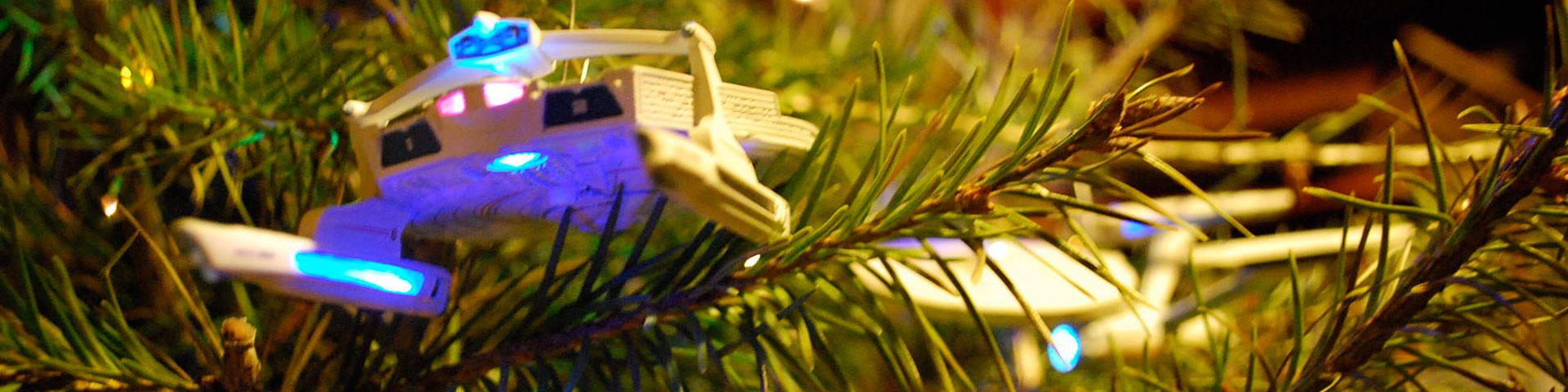
What is the Geek Tree? It’s a Christmas tree with a speculative fiction theme. And what’s speculative fiction? Speaking broadly, it’s a uber-genre comprised of science fiction, fantasy and horror, though in the case of the Geek Tree, it’s primarily sci-fi. The tree is re-built annually by Ken Newquist, Nuketown’s editor.
The History of the Geek Tree
“We’re kicking off our fun old-fashioned family Christmas by heading out into the country in the old front-wheel drive sleigh to embrace the frosty majesty of the winter landscape and select that most important of Christmas symbols … the Chrismas tree.” – Clark Griswold, National Lampoon’s Christmas Vacation
I got my first geek ornament in 1992. It was the Shuttlecraft Galileo from the original Star Trek series and featured Leonard Nimoy offering holiday greetings. Over the next few years my collection slowly grew, usually with one or two new Star Trek ornament received as Christmas and birthday presents.
At the time, no one really minded my ornaments on the tree, not when I was living with my parents, and not when my wife Sue and I moved in together in 1995. Then in 1997 something happened — I started accumulating ornaments as a greatly accelerated rate. That year I picked up four; then in 1998, I got eight. By the Christmas of 2001, I had 22 ornaments and my collection was on the verge of conquering a significant percentage of the Christmas tree. People started making comments. Sue asked if all the ornaments had to go up on the tree. And I was expecting even more ornaments to arrive with the holidays.
It was time to make the jump to the Unknown Regions.
In 2001, I bought a $20 artificial tree at Wal-mart — a 5-foot “evergreen”. When I opened the box, I was skeptical — the branches seemed a little thin for supporting the weight of the larger ornaments — but though the boughs bent, they did not break.
A tradition was born. And the collection grew. Each Christmas two to three new ornaments arrived from my parents and family and they were augmented by another three to four ornaments purchased after the holiday at Hallmark’s 50% off sale. Around 2004, the 5-foot-tall Geek Tree gave way to a 7-foot-tall one. That lasted for a good decade until 2016, when I finally found the tree I’d been looking for: a narrow, 9-foot-tall tree that towers over the library.
Designing the Geek Tree
“Clark … that tree wouldn’t fit in our front yard.” – Ellen Griswold
“It’s not going in our front yard … it’s going in our living room” – Clark Griswold
— National Lampoon’s Christmas Vacation
The First Iteration
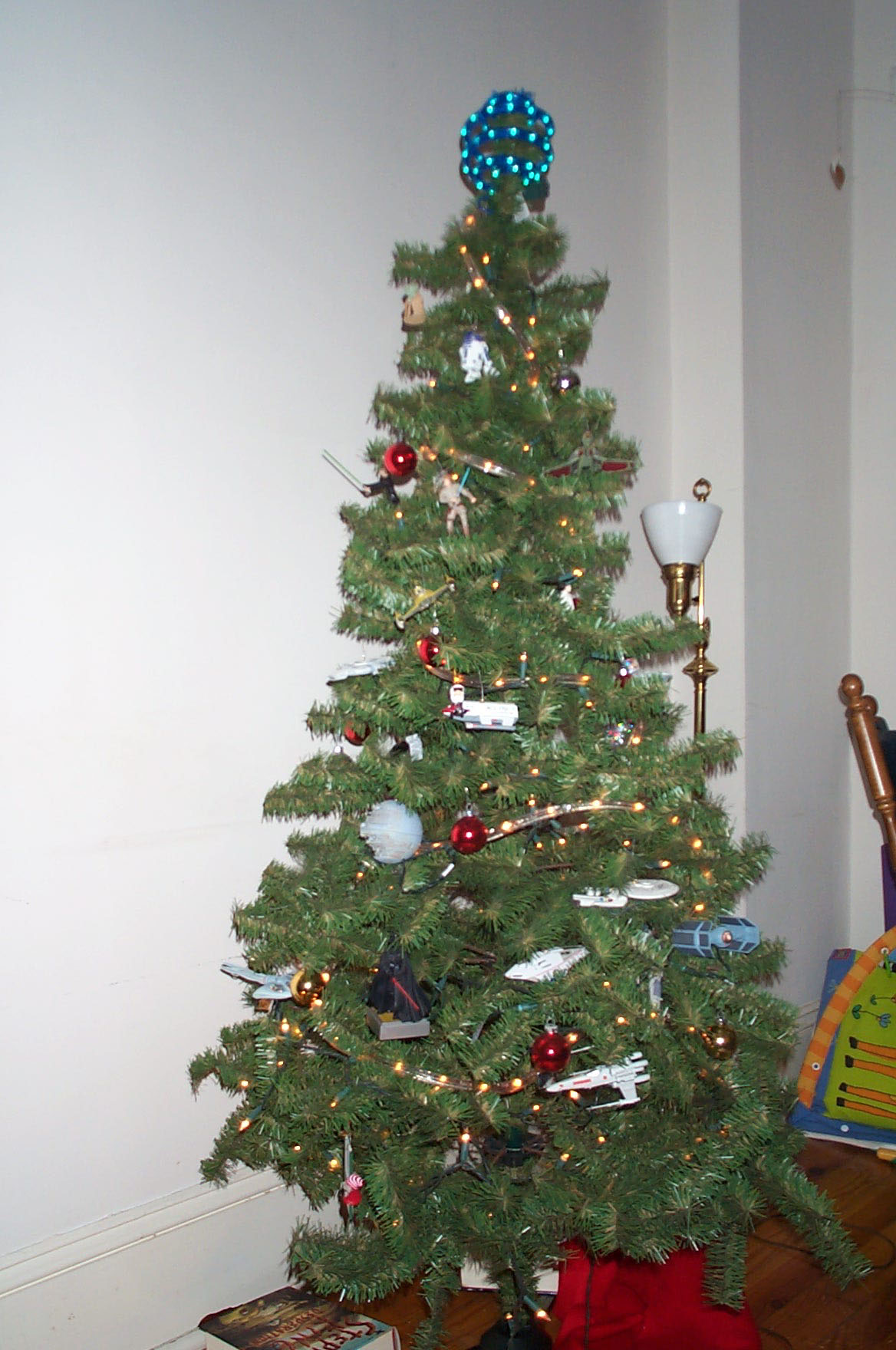
The earliest versions of the geek tree used strands of colored lights at its base — one strand close to the tree, the second lying near the outside.
The powered ornaments on the tree mandated the use of non-flashing lights (for one thing, the flashing might short the ornaments out. For another, even I would get sick of hearing the ornaments power up every few seconds).
Unfortunately, there were a couple of problems with the colored lights. First, the trees with colored lights tend to be slightly dimmer than white lights. The trees get even dimmer when you start removing lights and in favor of powered ornaments because the ornaments are never as bright as the bulbs they replace.
Second, you need to pay attention to exactly what colors you’re removing. The first time around I didn’t do that and unwittingly ended up way too many pink lights. The next year I used a brighter strand of colored lights, hoping the tree would stand out more. It worked … somewhat. But the problem with having too many of the same color lights remained.
In 2002 I moved to white lights, and that helped considerably, providing the powered ornaments with the energy they needed and brightening the tree considerably, but it was still too dim. And there was another problem that adding another strand of white lights wouldn’t solve — the tree just didn’t move. I don’t mean that it didn’t physically move (memories of my grandparents’ fake-fruit-covered artificial rotating tree are enough to turn me off to spinning Christmas trees)l. What I mean is that it didn’t have any visual motion to it — it just sat there.
I remedied that problem by adding chasing lights to the tree in 2003. These lights were encased in a plastic tube (a la Buck Rogers’ runway lights, which furthers the sci-fi theme) and “chased” each other up the tree. It worked out great — the lights animated the tree while simultaneously providing the boost of illumination the ornaments needed.
The Second Iteration
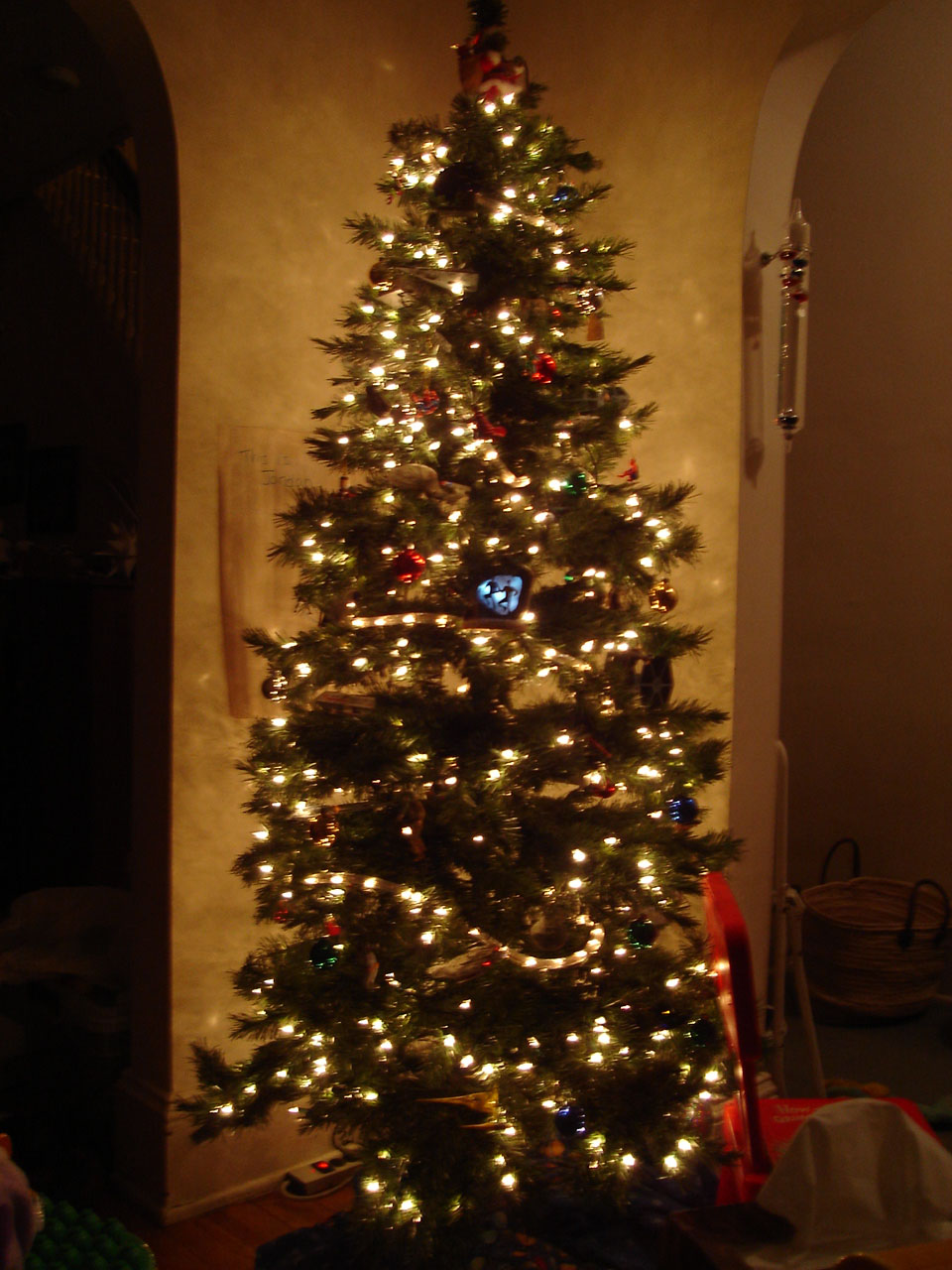
After that Christmas, it was clear that the original Geek Tree was on the verge of being overloaded by the sheer number of ornaments. It was time for an upgrade, and in 2004 I bought a new tree: a seven-foot-tall “narrow” tree about three feet in diameter.
It was pre-lit, and to make sure I don’t lose any of these not-easily-replaceable bulbs, I use a second string to power the tree’s myriad ornaments. The other notable upgrade in 2004 was the addition of the “geek tree” skirt. Made by my mom as a Christmas present, the quilted skirt features rockets and ringed planets on a blue background.
In 2005 I finally found an adequate tree topper — a 6.5″ tall Santa Yoda. Since he wasn’t designed as a tree topper, I had to attach him with strategically placed rubber bands.
The Third Iteration
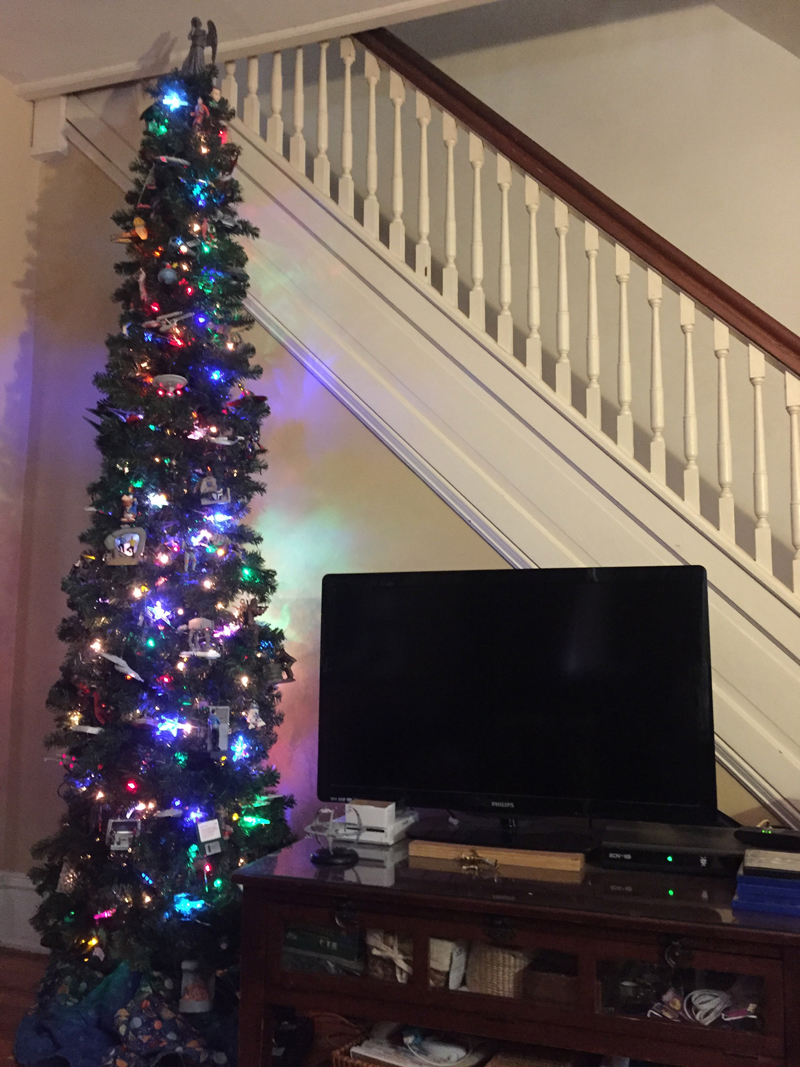
The third iteration began in 2015 when the Buck Rogers racing lights died and were replaced by IKEA’s excellent KILOMETER string lights. These star lights slowly change colors, growing in intensity then fading into another shade. They were a fantastic addition to the tree; while I enjoyed the science fiction feel of the Buck Rodgers lights, the KILOMETER lights add depth and color to the tree. They’re also incredibly relaxing to watch; I love laying down on the couch, a comic book on my chest, and looking over to watch the lights slowly pulse their way through the rainbow.
About this time the tree received a major dose of Doctor Who as ThinkGeek’s >Weeping Angel Tree Topper finally came back into stock. While Santa Yoda served the Geek Tree well as a tree topper, he’s got nothing on a Weeping Angel. Further Who-izing the tree is a strand of TARDIS string lights. They’re a subtle addition, with the white of the police box windows adding a bit of brightness to the tree.
The biggest change in the third iteration was the tree itself. In 2016 I replaced the 7-foot narrow geek tree with a 9-foot narrow tree. Its diameter is slightly less than that of the old tree but it stands 2 feet taller. The smaller diameter does cost me some surface area, but it’s easier to get around the tree now, and the tree itself is pretty damn impressive.
This may be the final iteration for now; the next logical step would be to increase the diameter of the tree, but there’s no way our current house can accommodate a full-size geek tree and a full-size family tree.
Geek Tree Gallery
Geek Tree 2003
Geek Tree 2005
Geek Tree 2006
Geek Tree 2008
Geek Tree 2010
Geek Tree 2013
Geek Tree 2014
The first year of the pulsing IKEA star lights, which turned out to be one of my favorite additions to the Geek Tree. Other additions included the Alien and the flying DeLorean from Back to the Future, Part II. Read about Geek Tree 2014.
Geek Tree 2015
The last year of the 7′ tree saw two Doctor Who-themed additions: The Weeping Angel Tree topper and TARDIS string lights. Read about Geek Tree 2015.
Geek Tree 2016
The first year of the 9′ tall geek tree. It saw the addition of the gold Enterprise and the Alien Queen. Read about Geek Tree 2016.
Geek Tree 2017
The 2017 edition of the Geek Tree introduced Hallmark’s “Storyteller” ornaments and some vintage Space Race ornaments. Read about Geek Tree 2017.